Wow, it's been awhile since I've updated here! Nothing much to report, I guess...
I recently accidentally attended a very different kind of church service. I guess you could put it in the category of "non-denominational protestant mega church." It was accidental, because I had been invited to a "dedication ceremony" of a baby of a friend of mine (yeah, I know what you're thinking, "whatever that is...") which I assumed would be a 15-20 minute ceremony after their evening church service. Nope. It was part of their 1.5 hour regular weekend service!
While I have been to Protestant services before, it's been awhile, and they have always only ever been of the "communion" variety, like Lutheran and Methodist. I have never actually been to a service which to me was really just like a "prayer meeting."
Overall, it seemed like quite a nice church, and I can see the attraction of it for so many people, (enabling it to become a "mega" church.) The "sanctuary" was actually not as big as I would have expected, especially considering the massive exterior of the church. Maybe it would seat 400? Super comfy chairs, which were necessary, as you will see later. Huge, cozy gathering space with coffee and snacks, and even an "Information" desk, along with lots of meeting rooms and a large kids space which made it such a big building.
I remember hearing from a priest-friend of mine, that the mega church up the road from him consisted of 70% "ex-Catholics." I don't know where he got that statistic, but it wouldn't surprise me, and I was thinking of that while I was attending this service. Catholic churches are in general pretty terrible at spiritually "feeding" their parishioners, as well as "plugging them in." The things that enable them to do this that made this church contrast so much what I see in Catholic churches includes: the geographic layout of this church (as described above,) the invitations to get involved with groups and, for example, to take a course to become a member of the church were really that - invitations and not announcements; even the pastor genuinely invited anyone to come meet with him or any of the staff to talk about, well, just about anything!
The service began with a snazzy little countdown clock (from 3 minutes) on the screens, enabling people to settle in their seats and quiet down. Then the pastor came out and just started talking - welcoming people and I suppose giving announcements (but like I described above, they were really more "invitations,") as well as talking a little to focus on what the "message" would be for the day.
Then there was the "dedication" ceremony, which is what I was there for. The pastor was careful to explain that this was not the children being "saved," (he never used the word "baptism,") but rather was more for the parents to be promising to raise their children to come to know Christ. It sounded like they do this once a year, and there were only 4 families up there. I'm not sure if there was a similar ceremony at all 5 of their weekend services, or if this was the only one. I was curious (and will ask my friend) if this is something that the church encourages (it seemed to me that if that were the case, there should have been more families up there.) If the church doesn't necessarily "encourage" it, then I'm going to draw my own conclusion that this is something that the church decided to offer in order to "appease" the families who have ties to denominations that actually do practice infant baptism, and feel like they ought to be "doing something." ;-)
Then they had a couple praise and worship type songs. VERY loud and rock-concert-y. I didn't know any of the songs at all, but they really drew them out (I assume,) since each song was like almost 10 minutes. I was quite impressed when I noticed that no one had any music in front of them. (Keyboardist, couple guitars, and couple singers.) They definitely practiced a lot to know exactly how long to make each song (when to do the bridge, refrain, etc,) as well as simply knowing the music!
After that came the pastors "message." (Or whatever it's called.) Now is when we were grateful for the super cozy chairs... Let's just say that might be one of the reasons Catholics would never sit through a 40-minute sermon! Well, I was quite impressed. 40 minutes actually seemed to go by quite quickly. The pastor said some really good things, inspiring to me, even mentioning the problem with abortion. In the bulletins there was a little piece of paper that had some key sentences/questions, so if you were paying attention, you could fill them in. (I thought that was a nice touch. I can see how that would help you to focus.) Overall, this church definitely gets the "Christian message" correct without watering it down (even though I obviously disagree with some of their theology.) I'm curious (and will also ask my friend) if the church has a public opinion on "gay marriage." My guess would be that officially they are opposed to it, but rarely/never preach against it (like in most Catholic churches...) for fear of alienating people or whatever.
At the beginning of the pastors message, he made a big deal about getting out a Bible (which were under the chairs,) and looking up the different passages that he talked about. But I want to point out to anyone who thinks Catholics don't read the Bible enough... at our church service, we definitely read WAY more Scripture! Their pastor read some of the "Before you formed me in my mothers womb" Psalm during the dedication, and then during his message he read about 5 verses from Genesis, and a couple other verses from (I can't remember where.) Not a ton! (Especially when you're sitting there with your Bible open on your knee, waiting for him to keep reading for 40 minutes!) At a Catholic service, we read like 5-20 verses for each of the three readings, plus another 5-10 for the Psalm! That doesn't even include the other Biblical references throughout the entire liturgy. But I definitely have to give this church credit - they did make a big deal about reading the Bible on your own, and even taking home the one in the pew if you don't have one. That was inspiring to me and a good reminder.
The service closed with a song and then the music leader being like, "Well, have a good weekend, everyone." Yup. Even he seemed to realize that's an awkward way to end the service, but you have to say something! I'm slightly surprised (but not really) that they don't use some Biblical blessing/dismissal, like "Go and preach the Good News of the Gospel!" Something a little more inspiring and like "now we're done!"
So overall, I was impressed but not really surprised with the service. I can see why it's so attractive, and why so many ex-Catholics might go there. Great music, and an inspiring sermon that actually does call you on to be a better Christian. The pastor was a great speaker, easy to listen to and very personable. I can imagine that people of all sorts of spiritual levels would enjoy a sermon like that. Contrast that to the homily we had at my parish this weekend... It was literally 3 minutes long on Saturday, and 4 today. (For reference, it was actually our deacon who gave it, and not the priest. I have never been impressed with anything theologically that the deacon said.) His whole homily was basically like "just love each other like Jesus wants us to." (Like it always is when he preaches.) No wonder Catholics who have a spiritual background would feel like they've never been "fed" would be drawn to a mega church. And of course, if you don't understand what "liturgy" is, or the purpose of the smells and bells, the music is a million times more entertaining at a mega church!
Sunday, May 12, 2013

Sunday, March 03, 2013
EF!
So I went to the Extraordinary Form Mass today at this church, and you know what the funny thing was that I realized as I was pondering what to write in this post? There really isn't much to write about the different EF's all around town... they're all pretty much the same! The choir/cantor could be more or less nice; it could be a solemn mass, missa cantata, or low mass, and the people could sing/speak more or less as a tradition at that parish, but other than that... there's not much to write about! (And that's a GOOD thing!)
As for this liturgy, I did enjoy it a great deal. The church is quite lovely inside, and they have a fabulous, recently rebuilt organ. There was a wonderful male cantor with a beautiful tenor voice (and the priest also had quite a lovely voice!) but I did feel like the rest of the choir distracted from his execution of the propers, but they were fine for all the ordinary chants (the congregation sang heartily for the simple responses, but I suspect the ordinary was more foreign for them.) (My recommendation for the tenor, who sang the chants relatively high, would be to either not have the choir sing the propers with him, OR to have them only sing in his range, then their, um... "wanderings" wouldn't be quite as noticed as they were an octave higher...)
I was there for a baptism which followed Mass, also in the EF. (I think it was my 2nd or 3rd of those?) One neat thing to be mentioned from that was how the priest encouraged/taught us all the simple response for the part when everyone walks in procession to the front of the church. (Something like "let us go to the house of the Lord," I can't remember exactly.) So it was neat to be able to sing that response as a group after each verse.
As for this liturgy, I did enjoy it a great deal. The church is quite lovely inside, and they have a fabulous, recently rebuilt organ. There was a wonderful male cantor with a beautiful tenor voice (and the priest also had quite a lovely voice!) but I did feel like the rest of the choir distracted from his execution of the propers, but they were fine for all the ordinary chants (the congregation sang heartily for the simple responses, but I suspect the ordinary was more foreign for them.) (My recommendation for the tenor, who sang the chants relatively high, would be to either not have the choir sing the propers with him, OR to have them only sing in his range, then their, um... "wanderings" wouldn't be quite as noticed as they were an octave higher...)
I was there for a baptism which followed Mass, also in the EF. (I think it was my 2nd or 3rd of those?) One neat thing to be mentioned from that was how the priest encouraged/taught us all the simple response for the part when everyone walks in procession to the front of the church. (Something like "let us go to the house of the Lord," I can't remember exactly.) So it was neat to be able to sing that response as a group after each verse.
Sunday, February 10, 2013
The people who affect us
It's funny how many people and circumstances have affected our lives in ways that we probably cannot even comprehend.
A few days ago, a man died who possibly had the largest most indirect effect on my vocation/career as an organist. His funeral was yesterday, and while I barely even knew him, and I'm sure he wouldn't even have recognized me, it's funny to think about how one little person/circumstance can change your life so much.
I was an undergraduate non-music major in college, and this man was friends with my mom and also close friends with the head of the organ department. When I mentioned to my mom that I thought the organ might be a neat instrument to learn to play, she arranged a meeting with the head of the organ department through the friendship of this man. Would I have become an organist without this bit of serendipity? God only knows. On the other hand, since I do think that what I do now is divinely inspired, I suppose that most likely, yes, other circumstances would have occurred to have the same result, and yet, it's so funny. I never would have imagined that that little meeting, and my chance remark about wanting to learn the organ would have changed the course of my life.
May the souls of the faithful departed, through the mercy of God, rest in peace.
RIP, Paul Melton.
A few days ago, a man died who possibly had the largest most indirect effect on my vocation/career as an organist. His funeral was yesterday, and while I barely even knew him, and I'm sure he wouldn't even have recognized me, it's funny to think about how one little person/circumstance can change your life so much.
I was an undergraduate non-music major in college, and this man was friends with my mom and also close friends with the head of the organ department. When I mentioned to my mom that I thought the organ might be a neat instrument to learn to play, she arranged a meeting with the head of the organ department through the friendship of this man. Would I have become an organist without this bit of serendipity? God only knows. On the other hand, since I do think that what I do now is divinely inspired, I suppose that most likely, yes, other circumstances would have occurred to have the same result, and yet, it's so funny. I never would have imagined that that little meeting, and my chance remark about wanting to learn the organ would have changed the course of my life.
May the souls of the faithful departed, through the mercy of God, rest in peace.
RIP, Paul Melton.
Thursday, February 07, 2013
Gypsy Funeral!
Well, I thought it was going to be much more interesting than it turned out to be, but I guess since my liturgical life in general hasn't been all that interesting as of late, it's worth sharing about...
So, I still haven't quite figured out what exactly made them "Gypsy;" it was mentioned during the funeral that someone was from Romania, and other than that they looked like pretty normal dark-haired people. Well, they were interesting in other ways, I suppose... A fair bit of getting up to light candles, walking across the aisle to talk to someone, or going outside for a smoke right in the middle of the funeral! (They didn't hesitate to say the responses, however, but those from the previous missal!)
The most interesting thing was probably the "band" that they had - it was (I think) an accordian, a couple of violins, and a bass. They walked up the aisle right before the casket, which was actually pretty neat, and played, and also after Mass.
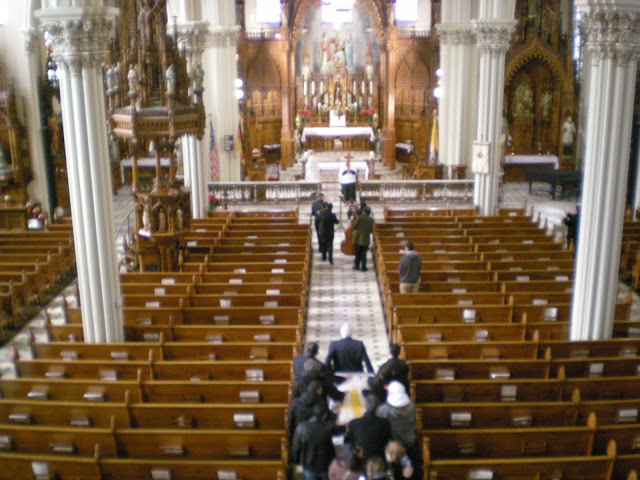
You can see them in here. (And yes, I'm also posting it since I don't think I've ever posted a picture of my church, to make you all jealous! ;-) ) I did notice, however, that *many* of the people in the family "procession" had their iphones out taking a video of the instruments and the church, so this apparently was not a normal occurence for them, either!
I wish I could describe the song they played (same song at beginning and end.) It was interesting. The best word I could think of to describe it would be "bawdy" sounding. Lilting and rather modal. I guess if I had to think of a song that might be considered "gypsy," this would certainly fit.
The only unfortunate thing that happened, was the funeral director had told me they were going to sing something right after Communion, so I *thought* that I ended the Communion song in a timely manner, but apparently not, b/c during the last verse I could see the funeral director jumping around and waving at me in my mirror ("No, I am NOT going to stop in the middle of a verse...") and then it appeared he gave up in frustration? Meanwhile, Father was still "doing the dishes" for another minute or two, so I don't know why they didn't just do the song then. But on the other hand... maybe not such a bad thing. Father and I had NO idea what they were going to sing, and, well, let's just say that impromptu music at Masses and funerals especially, in my experience, is rarely appropriate...
So, I still haven't quite figured out what exactly made them "Gypsy;" it was mentioned during the funeral that someone was from Romania, and other than that they looked like pretty normal dark-haired people. Well, they were interesting in other ways, I suppose... A fair bit of getting up to light candles, walking across the aisle to talk to someone, or going outside for a smoke right in the middle of the funeral! (They didn't hesitate to say the responses, however, but those from the previous missal!)
The most interesting thing was probably the "band" that they had - it was (I think) an accordian, a couple of violins, and a bass. They walked up the aisle right before the casket, which was actually pretty neat, and played, and also after Mass.

I wish I could describe the song they played (same song at beginning and end.) It was interesting. The best word I could think of to describe it would be "bawdy" sounding. Lilting and rather modal. I guess if I had to think of a song that might be considered "gypsy," this would certainly fit.
The only unfortunate thing that happened, was the funeral director had told me they were going to sing something right after Communion, so I *thought* that I ended the Communion song in a timely manner, but apparently not, b/c during the last verse I could see the funeral director jumping around and waving at me in my mirror ("No, I am NOT going to stop in the middle of a verse...") and then it appeared he gave up in frustration? Meanwhile, Father was still "doing the dishes" for another minute or two, so I don't know why they didn't just do the song then. But on the other hand... maybe not such a bad thing. Father and I had NO idea what they were going to sing, and, well, let's just say that impromptu music at Masses and funerals especially, in my experience, is rarely appropriate...
Monday, January 21, 2013
A Tale of Two Churches
My priest gave a fabulous homily yesterday... he talked about ways to receive Communion, and how the pope now only gives Communion to people kneeling, and how while the US bishops gave "permission" (and made it the norm) to receive standing and in the hand, he was encouraging people to try to receive kneeling, and he even brought out a kneeler and said that anyone who wants to could use it during Communion.
OTOH, at my husband's parish (the largest in the diocese,) this week they printed a blurb with very careful wording that really did say/imply that you should receive standing, since that is the norm in the US. ugh
What a contrast.
The thing that strikes me the most about one of the things my priest said (and I've known this, just never thought to put it in words,) the way we receive Communion is instructive. He said that quote that I've heard before, "(Some non-Catholic said), 'If you Catholics really believed what you said you did about the Eucharist, you would be crawling up the aisle to receive.' " Our body posture not only demonstrates what we believe, but our beliefs can change b/c of what our body posture is!
So... I just feel rather depressed about that whole situation, especially the arrogance of the pastor at my husband's parish who thought that was an appropriate thing to put in the bulletin. (Keep in mind, this huge parish, for the first 30 years of it's existence, up until this new pastor came in 3-4 years ago, was a GREAT parish. No hanky-panky silliness was tolerated!)
The thing that gives me consolation, is my strongly held belief that, in my lifetime, we will see a return to either mandated reception kneeling and on the tongue, or else everyone will naturally go that way. The Church cannot be sustained while continuing to treat the reception of Communion in such a casual manner. I know that there are many people (especially those reading this) who do receive on the hand who do NOT have casual views of the Eucharist, (I myself receive on the hand for a variety of reasons,) but I think that overall within the Church in the US, the lax attitude towards Mass and the Eucharist is either encouraged or enabled by reception standing.
Sunday, January 06, 2013
Silver Trumpets!
Before time flies away and I forget, I really have to blog about my experience at this church this morning. The music and architecture came highly recommended, and I even forgot about one of the biggest reasons I was going there until it actually happened... silver trumpets at the elevation! Not just trumpets, but the organ (resultant? and some other stuff?) and timpani. Quite spectacular. I mean, a little *too* spectacular, and you can see why it's not technically "allowed" as it was definitely musically distracting... I wanted to burst into applause right after; it was such a grand chorus!
The church itself was gorgeous, and I think might be even prettier than my own. :-(
As for the liturgy, it was decently done, minus the "Angels We Have Heard on High" substituting for the Gloria, {eyeroll} and the responsorial Psalm that was definitely not any "Psalm" text I've ever heard. I was impressed with how the priest chanted the Gospel.
Pope John Paul visited the church in 1969 (before he was pope) and the miter (?) that he wore is enshrined as a relic.
ETA: I forgot to mention! The priest sang the Epiphany Proclamation (where they announce the dates for all of the upcoming moveable Feasts like Easter for the next year.) I had only just heard of that a few days ago, so it was cool to see it in action!
The church itself was gorgeous, and I think might be even prettier than my own. :-(
As for the liturgy, it was decently done, minus the "Angels We Have Heard on High" substituting for the Gloria, {eyeroll} and the responsorial Psalm that was definitely not any "Psalm" text I've ever heard. I was impressed with how the priest chanted the Gospel.
Pope John Paul visited the church in 1969 (before he was pope) and the miter (?) that he wore is enshrined as a relic.
ETA: I forgot to mention! The priest sang the Epiphany Proclamation (where they announce the dates for all of the upcoming moveable Feasts like Easter for the next year.) I had only just heard of that a few days ago, so it was cool to see it in action!
Wednesday, November 28, 2012
matching pitch!
So I mentioned recently that I "conduct" a small choir of 8th-11th graders; 6 boys and 6 girls. With MANY frustrations, ranging from their still-changing voices, to the adolescent insecurities. Sigh. But overall, they're great kids.
One of my extreme frustrations has been that two of the guys have GREAT difficulty matching pitch. They are ok once I help them "work up" to the correct note, but then later they usually can't find it on their own. I think that the problem with one of them is that he truly can't hit even a middle C (except maybe with his head voice, but combined with his already handicapped pitch-matching, he hasn't learned how to access that register out of the blue,) and then it's a lot like the blind leading the blind! But, I have to say, these two guys do seem to have some of the best attitudes in the choir! (It's super cute.)
So I have been working with them, and the whole choir, and working with them especially on matching pitch, (but there is not a whole lot we can do in the 1 hour twice a week with all the other kids!) but today I was so happy, b/c I had actual confirmation that they are both getting better! I tried to get all the kids to audition for a couple solos, and they were all VERY reluctant, and I had the 2 most confident singers do it (and do a great job,) AND THEN both these young men asked to sing it, and they both sang it correctly! I was soooooo happy!
It's just been... particularly frustrating b/c I feel like I can hardly do anything with the choir when I have at least 2 people who can barely match pitch, but since I KNOW that neither of them could have done anything close to this 3 months ago at the beginning of the school year, I know that they are improving! It's just so.... heartening!
One of my extreme frustrations has been that two of the guys have GREAT difficulty matching pitch. They are ok once I help them "work up" to the correct note, but then later they usually can't find it on their own. I think that the problem with one of them is that he truly can't hit even a middle C (except maybe with his head voice, but combined with his already handicapped pitch-matching, he hasn't learned how to access that register out of the blue,) and then it's a lot like the blind leading the blind! But, I have to say, these two guys do seem to have some of the best attitudes in the choir! (It's super cute.)
So I have been working with them, and the whole choir, and working with them especially on matching pitch, (but there is not a whole lot we can do in the 1 hour twice a week with all the other kids!) but today I was so happy, b/c I had actual confirmation that they are both getting better! I tried to get all the kids to audition for a couple solos, and they were all VERY reluctant, and I had the 2 most confident singers do it (and do a great job,) AND THEN both these young men asked to sing it, and they both sang it correctly! I was soooooo happy!
It's just been... particularly frustrating b/c I feel like I can hardly do anything with the choir when I have at least 2 people who can barely match pitch, but since I KNOW that neither of them could have done anything close to this 3 months ago at the beginning of the school year, I know that they are improving! It's just so.... heartening!
Sunday, November 18, 2012
The most well-attended organ concert to which I have ever been...
There's the old joke in organ circles, that you can invite the most famous organist to give a concert, and you'll still only have about 40 people attend; 100 people is a huge concert! Well, today we saw what happens when you have a musical pastor who is onboard 110% with the organ program.
We went to a formal organ blessing ceremony of a new/refurbished organ by the bishop (I've never been to one,) followed immediately by an organ concert at a large church in the diocese. And the church was FULL. I'm terrible with numbers, but there was at least 500 people there! How does that happen? It was apparent that this project had the full support of their musically inclined pastor (also an organist- no surprise! Good things happen when organists become priests, this isn't the first time that's happened!)
As for the ceremony/concert itself, I thought that it was so well-done, that I'm going to keep the program to remind myself of it, on the off-chance that I'm ever in such a situation myself. (HA!)
It was a wonderful mix of choral pieces, hymns arranged for congregation and choir (all conveniently placed to give the congregation a standing-breather!), and of course organ music.
The organ was silent and only the choir and handbells were utilized up until the formal blessing by the bishop, at which time Karg-Elert's Nun Danket was performed. I enjoyed the R.V. Williams version of All People that on Earth, (as it reminded me of 6 years ago when I used that exact same arrangement for my parish's 175th anniversary Mass when the bishop attended, and it was totally botched b/c it hadn't occurred to me that the people would keep singing during the interludes! Oops... Wow, I've learned a lot since then... I'm glad to see that it was successfully pulled off today!) Among other pieces, there was also a Concerto by Handel, Mozart's Lacrymosa (yay!), Messiaen's Apparition de l'Eglise eternelle, and some movements of Mussorgsky's Pictures at an Exhibition with which I'm not at all familiar, but I greatly enjoyed. And it was closed with the Hallelujah Chorus. Overall, a very enjoyable 2-hour event. As the battles rage about electronic vs. authentic pipe organs*, it was lovely to see a parish and pastor supporting this organ project, and through it, music for future generations!
(*and on that controversy, allow me to add two points:
Sacrosanctum Concilium, the primary Vatican II document on the Sacred Liturgy, explicitly says in paragraph 120,
"In the Latin Church the pipe organ is to be held in high esteem, for it is the traditional musical instrument which adds a wonderful splendor to the Church's ceremonies and powerfully lifts up man's mind to God and to higher things." Ahem. Pipe organ.
Secondly, when was the last time that you had a regularly-used electronic device that lasted even longer than, oh, 15 years? If properly maintained, this new pipe organ has the potential to last hundreds of years! The "cost savings" of an electronic instrument is not quite as direct as it seems at first glance...)
We went to a formal organ blessing ceremony of a new/refurbished organ by the bishop (I've never been to one,) followed immediately by an organ concert at a large church in the diocese. And the church was FULL. I'm terrible with numbers, but there was at least 500 people there! How does that happen? It was apparent that this project had the full support of their musically inclined pastor (also an organist- no surprise! Good things happen when organists become priests, this isn't the first time that's happened!)
As for the ceremony/concert itself, I thought that it was so well-done, that I'm going to keep the program to remind myself of it, on the off-chance that I'm ever in such a situation myself. (HA!)
It was a wonderful mix of choral pieces, hymns arranged for congregation and choir (all conveniently placed to give the congregation a standing-breather!), and of course organ music.
The organ was silent and only the choir and handbells were utilized up until the formal blessing by the bishop, at which time Karg-Elert's Nun Danket was performed. I enjoyed the R.V. Williams version of All People that on Earth, (as it reminded me of 6 years ago when I used that exact same arrangement for my parish's 175th anniversary Mass when the bishop attended, and it was totally botched b/c it hadn't occurred to me that the people would keep singing during the interludes! Oops... Wow, I've learned a lot since then... I'm glad to see that it was successfully pulled off today!) Among other pieces, there was also a Concerto by Handel, Mozart's Lacrymosa (yay!), Messiaen's Apparition de l'Eglise eternelle, and some movements of Mussorgsky's Pictures at an Exhibition with which I'm not at all familiar, but I greatly enjoyed. And it was closed with the Hallelujah Chorus. Overall, a very enjoyable 2-hour event. As the battles rage about electronic vs. authentic pipe organs*, it was lovely to see a parish and pastor supporting this organ project, and through it, music for future generations!
(*and on that controversy, allow me to add two points:
Sacrosanctum Concilium, the primary Vatican II document on the Sacred Liturgy, explicitly says in paragraph 120,
"In the Latin Church the pipe organ is to be held in high esteem, for it is the traditional musical instrument which adds a wonderful splendor to the Church's ceremonies and powerfully lifts up man's mind to God and to higher things." Ahem. Pipe organ.
Secondly, when was the last time that you had a regularly-used electronic device that lasted even longer than, oh, 15 years? If properly maintained, this new pipe organ has the potential to last hundreds of years! The "cost savings" of an electronic instrument is not quite as direct as it seems at first glance...)
Friday, November 16, 2012
Today
Two cute things happened today.
First, I requested a book about choral conducting through the inter-library loan program. I got it today. It came from a nearby university's music library, and included a hello-note from someone who works there whom I have never met. Small music world...
Secondly, (most of the reason for my requesting the above-mentioned book,) I teach/conduct a tiny high school choir of 12 students twice a week. There are many, um, difficulties and ups and downs in this job. I was told today by the woman "in charge," that one of the girls (the girl whom I had pegged immediately as having a bit of a "too cool for this/I don't wanna be here" type attitude,) this girl had walked up to her after our last choir rehearsal and said, "I really like choir. I'm learning a lot!"
WOOT!
Even in my random, crazy, multiple-job life, I get to experience a tiny bit of what "real" teachers go through.
You can't put a price tag on such an experience and knowing how you might be affecting a young person!
:-D
First, I requested a book about choral conducting through the inter-library loan program. I got it today. It came from a nearby university's music library, and included a hello-note from someone who works there whom I have never met. Small music world...
Secondly, (most of the reason for my requesting the above-mentioned book,) I teach/conduct a tiny high school choir of 12 students twice a week. There are many, um, difficulties and ups and downs in this job. I was told today by the woman "in charge," that one of the girls (the girl whom I had pegged immediately as having a bit of a "too cool for this/I don't wanna be here" type attitude,) this girl had walked up to her after our last choir rehearsal and said, "I really like choir. I'm learning a lot!"
WOOT!
Even in my random, crazy, multiple-job life, I get to experience a tiny bit of what "real" teachers go through.
You can't put a price tag on such an experience and knowing how you might be affecting a young person!
:-D
Monday, October 15, 2012
Chicago!
Recently we had the opportunity to attend Mass at one of the COOLEST churches in the country... Saint John Cantius in Chicago!
And it was every bit as neat as I remembered! The last time I had been there was almost exactly 4 years ago, with a VERY random assortment of friends, and we took at 1-day road trip there for their All Souls Mass.
So this time, (due to our schedule,) we attended the Latin Novus Ordo Mass, which was sung by a male schola. VERY beautiful. I love how they do the procession at SJC, it was exactly like how I had envisioned the procession for my own wedding (which unfortunately didn't turn out like that at all, sigh...)
The schola sang all the propers and ordinaries in Latin and the proper chant; the readings, prayers of the faithful and homily were all in English.
Interesting things I noticed (and am not sure how I feel about) include the fact that the congregation sat at times like they would in the EF, when the priest sat, while the choir sang the Gloria and Credo. It is my understanding that the Credo is one of the parts that "belong to the people," and therefore they should always participate in singing or speaking it.
The priest sang the beginning of the Eucharistic Prayer (he used II) but then barely-audibly spoke the rest after the consecration.
And also, it was amazing to me how little organ music there was! One point that I noticed it, in contrast to the directives from the GIRM, was after communion. Unfortunately, I didn't make note of what the schola sang after they were done with the communion proper (throughout the rest of communion), but my understanding of the rubrics is that if there is not a congregational song after communion, that there should be silence; instead, there was a brief organ solo.
In the grand scale of liturgical "abuses," that is next-to-nothing, but I found it interesting.
It was really wonderful to be at a Mass in Latin where much of it was sung and where the congregation heartily sang the responses. Unfortunately, our experience was marred by the fact that some of the people we were with left at various points in the liturgy.
It really breaks my heart. THIS is the state of American ROMAN Catholicism?! Catholics who can't or won't even sit through a whole Mass, just because it is in LATIN?! That is the language of our church! I personally do not think that the Mass in Latin is the ideal, but I think it is something good that Catholics should be familiar with - for many reasons, but especially b/c of how it ties us together as Roman Catholics. You can go to Mass anywhere in the world and know what's going on if it's in Latin!
I really wanted to stay and look around a bit, but due to the situation above, we had to leave right after Mass. But overall, it was soooo beautiful, and soooo inspiring, and I am sooooo glad that we got to go!
And it was every bit as neat as I remembered! The last time I had been there was almost exactly 4 years ago, with a VERY random assortment of friends, and we took at 1-day road trip there for their All Souls Mass.
So this time, (due to our schedule,) we attended the Latin Novus Ordo Mass, which was sung by a male schola. VERY beautiful. I love how they do the procession at SJC, it was exactly like how I had envisioned the procession for my own wedding (which unfortunately didn't turn out like that at all, sigh...)
The schola sang all the propers and ordinaries in Latin and the proper chant; the readings, prayers of the faithful and homily were all in English.
Interesting things I noticed (and am not sure how I feel about) include the fact that the congregation sat at times like they would in the EF, when the priest sat, while the choir sang the Gloria and Credo. It is my understanding that the Credo is one of the parts that "belong to the people," and therefore they should always participate in singing or speaking it.
The priest sang the beginning of the Eucharistic Prayer (he used II) but then barely-audibly spoke the rest after the consecration.
And also, it was amazing to me how little organ music there was! One point that I noticed it, in contrast to the directives from the GIRM, was after communion. Unfortunately, I didn't make note of what the schola sang after they were done with the communion proper (throughout the rest of communion), but my understanding of the rubrics is that if there is not a congregational song after communion, that there should be silence; instead, there was a brief organ solo.
In the grand scale of liturgical "abuses," that is next-to-nothing, but I found it interesting.
It was really wonderful to be at a Mass in Latin where much of it was sung and where the congregation heartily sang the responses. Unfortunately, our experience was marred by the fact that some of the people we were with left at various points in the liturgy.
It really breaks my heart. THIS is the state of American ROMAN Catholicism?! Catholics who can't or won't even sit through a whole Mass, just because it is in LATIN?! That is the language of our church! I personally do not think that the Mass in Latin is the ideal, but I think it is something good that Catholics should be familiar with - for many reasons, but especially b/c of how it ties us together as Roman Catholics. You can go to Mass anywhere in the world and know what's going on if it's in Latin!
I really wanted to stay and look around a bit, but due to the situation above, we had to leave right after Mass. But overall, it was soooo beautiful, and soooo inspiring, and I am sooooo glad that we got to go!
Sunday, October 07, 2012
Free Sunday
Today was my free Sunday for the month. I went to a ... typical suburban parish.
We sang like ancient Aztecs and praised the sun and moon. Sigh.
Then, we sang one of the dumbest songs ever (well, dumb in the context of a Catholic liturgy. If it's for a religion that isn't theocentric and is just "feel good" and "believe whatever you want to believe," then it makes perfect sense.)
'Tis the gift to be simple, 'tis the gift to be free
'Tis the gift to come down where we ought to be,
And when we find ourselves in the place just right,
'Twill be in the valley of love and delight.
When true simplicity is gain'd,
To bow and to bend we shan't be asham'd,
To turn, turn will be our delight,
Till by turning, turning we come 'round right
...whatever THAT means.
And this is at the same church which has forbidden:
At that first Eucharist before you died,
O Lord, you prayed that all be one in you;
At this our Eucharist again preside,
And in our hearts your law of love renew.
Thus may we all one Bread, one Body be;
Through this blest Sacrament of Unity.
because the priest doesn't "like" it.
head >>> desk
And we wonder why most Catholics have the theological comprehension of an 8 year old.
We sang like ancient Aztecs and praised the sun and moon. Sigh.
Then, we sang one of the dumbest songs ever (well, dumb in the context of a Catholic liturgy. If it's for a religion that isn't theocentric and is just "feel good" and "believe whatever you want to believe," then it makes perfect sense.)
'Tis the gift to be simple, 'tis the gift to be free
'Tis the gift to come down where we ought to be,
And when we find ourselves in the place just right,
'Twill be in the valley of love and delight.
When true simplicity is gain'd,
To bow and to bend we shan't be asham'd,
To turn, turn will be our delight,
Till by turning, turning we come 'round right
...whatever THAT means.
And this is at the same church which has forbidden:
At that first Eucharist before you died,
O Lord, you prayed that all be one in you;
At this our Eucharist again preside,
And in our hearts your law of love renew.
Thus may we all one Bread, one Body be;
Through this blest Sacrament of Unity.
because the priest doesn't "like" it.
head >>> desk
And we wonder why most Catholics have the theological comprehension of an 8 year old.
Wednesday, September 19, 2012
Russian Orthodox
It's been a few weeks, so I should have written this while it was fresh in my mind, but I got a chance to go to the Russian Orthodox Cathedral! Talk about a LOT of standing and a long service! (Stood for 30 minutes, then 20 minute seated homily, then stood for another 30 minutes...)
I think I even saw a baby being baptized and (I assume) confirmation/chrismation and first communion. (I was only clued into that when the baby was being paraded around the church right before communion. Other than that everything else must have occurred behind the screen where I missed it!)
I had to leave around communion because at that point the service had already been 1.5 hours, so I don't know what I missed after that. I do remember that they had a nice choir that sang in 4 parts in a chant-like way for everything, - I wish I knew how to describe it - to the point where I didn't sing a thing except, oddly, I knew the melody of the Creed from somewhere, and I had no problem singing it while following along with the words! (It was some sort of chant tone. Maybe it was like, "mi--- re-do-re, re---do-ti-la" sung very energetically.)
Apparently, this cathedral is mostly famous for it's appearance in the 1977 film "The Deer Hunter." Interesting.
It would be very interesting to notate or record the various chant tones from all these different Eastern churches and to compare them for the specific parts of the liturgy.
I think I even saw a baby being baptized and (I assume) confirmation/chrismation and first communion. (I was only clued into that when the baby was being paraded around the church right before communion. Other than that everything else must have occurred behind the screen where I missed it!)
I had to leave around communion because at that point the service had already been 1.5 hours, so I don't know what I missed after that. I do remember that they had a nice choir that sang in 4 parts in a chant-like way for everything, - I wish I knew how to describe it - to the point where I didn't sing a thing except, oddly, I knew the melody of the Creed from somewhere, and I had no problem singing it while following along with the words! (It was some sort of chant tone. Maybe it was like, "mi--- re-do-re, re---do-ti-la" sung very energetically.)
Apparently, this cathedral is mostly famous for it's appearance in the 1977 film "The Deer Hunter." Interesting.
It would be very interesting to notate or record the various chant tones from all these different Eastern churches and to compare them for the specific parts of the liturgy.
Subscribe to:
Posts (Atom)